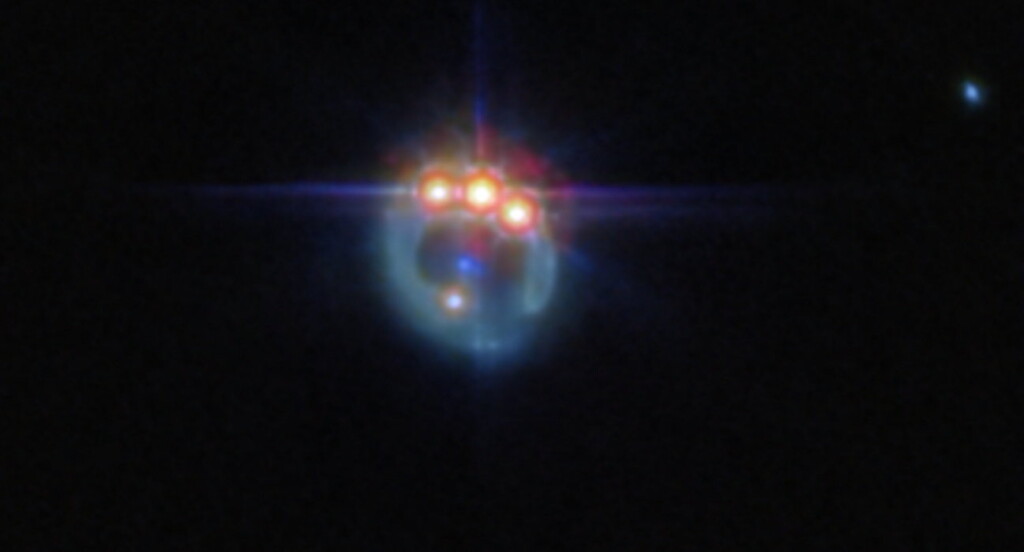
Diamonds of the season 💎
These glittering “gems,” or glowing orange dots, are actually four images of the same thing — an extremely bright object known as a quasar: https://t.co/sELuB7cHjB
So how did Webb end up with multiple copies? ⬇️ pic.twitter.com/dGgbTJdf9W
— NASA Webb Telescope (@NASAWebb) July 5, 2024
[/raw]nn nnAccording to a statement from ESA, gravitational lensing, first predicted by Einstein, offers a rare opportunity to study regions close to the black hole in distant quasars, by acting as a natural telescope and magnifying the light from these sources.nn”All matter in the Universe warps the space around itself, with larger masses producing a stronger effect. Around very massive objects, such as galaxies, light that passes close by follows this warped space, appearing to bend away from its original path by a clearly visible amount.”nnThis image was captured with Webb’s MIRI (Mid-Infrared Instrument) as part of an observation program to study dark matter, an invisible form of matter that accounts for most of the Universe’s mass.nnLOOK SKYWARD IN LATE JULY! Two Meteor Showers Peak in the Same Region of the Sky on the Same Night This MonthnnWebb’s observations of quasars are allowing astronomers to probe the nature of dark matter at smaller scales than ever before.nnSHARE THIS GEM With Astronomy Fans on Social Media…