
Van Gogh’s Painting Starry Night Is Scientifically Accurate, Says New Study

Licensed image by GNN / SWNS
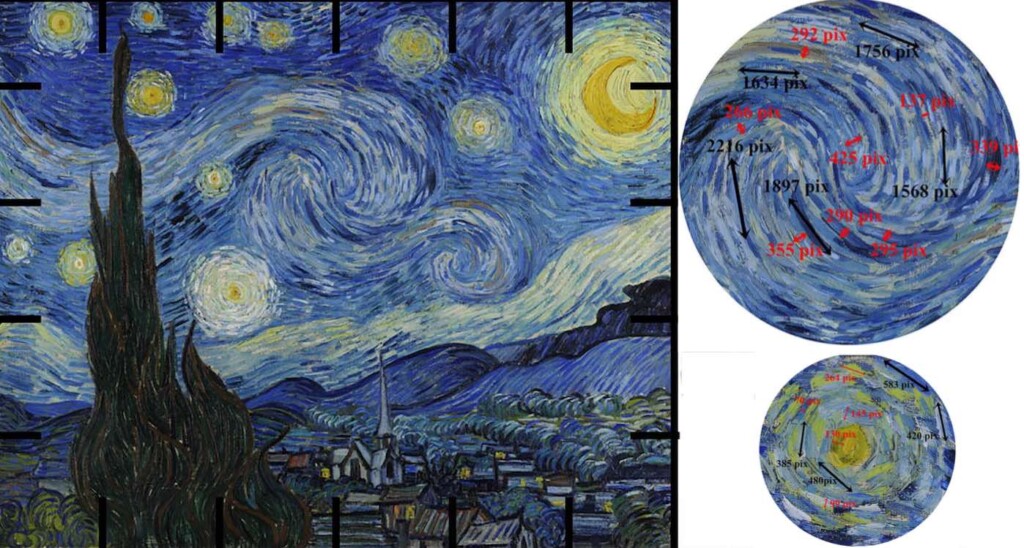
nnIt’s probably fair to say that Starry Night is the second most famous painting ever made behind the Mona Lisa, but what its many admirers likely do not know is that its famous swelling skies are “alive with real-world physics.”nnVan Gogh’s brush strokes create an illusion of sky movement so convincing it led atmospheric scientists specializing in marine and fluid dynamics in China and France to wonder how closely it aligns with the physics of real skies.nnThey explained that while the atmospheric motion in the painting cannot be measured, the brushstrokes can act as a stand-in.nnAnd, after measuring the relative scale and spacing of the whirling strokes, the researchers say van Gogh “accurately captures” cascading energy.nnThey discovered what they described as “hidden turbulence” in the painter’s depiction of the sky.nn“The scale of the paint strokes played a crucial role,” in this discovery, said study author Dr. Huang Yongxiang. “With a high-resolution digital picture, we were able to measure precisely the typical size of the brushstrokes and compare these to the scales expected from turbulence theories.”nnTo reveal hidden turbulence, the research team used brush strokes in the painting like leaves swirling in a funnel of wind to examine the shape, energy, and scaling of atmospheric characteristics of the otherwise invisible atmosphere.nnThey then used the relative brightness, or luminance of the varying paint colors as a stand-in for the kinetic energy of physical movement.nn“It reveals a deep and intuitive understanding of natural phenomena,” said Dr. Huang. “Van Gogh’s precise representation of turbulence might be from studying the movement of clouds and the atmosphere or an innate sense of how to capture the dynamism of the sky.”nnUNRAVELING MASTERPIECES: Small Town is Giddy With Excitement That it Appears in Background of World’s Most Famous Portrait–the Mona LisannThe study, published in the journal Physics of Fluids, analyzed the spatial scale of the painting’s 14 main whirling shapes to find out if they align with the cascading energy theory that describes the kinetic energy transfer from large to small-scale turbulent flows in the atmosphere.nnThey discovered the overall picture aligns with Kolmogorov’s law, which predicts atmospheric movement and scale according to measured inertial energy.nnOTHER STRANGE STORIES LIKE THIS: The Stonehenge ‘Altar Stone’ Mystery is Solved: It Came from Scotland 460 Miles AwaynnDrilling down to the microcosm within the paint strokes themselves, where relative brightness is diffused throughout the canvas, the research team also discovered an alignment with Batchelor’s scaling, which describes energy laws in small-scale, passive scalar turbulence following atmospheric movement.nnThey said finding both scalings in one atmospheric system is rare, and it was a “big driver” for their research.nnSHARE This Wild, New Discovery Hidden In Such A Well-Known Painting… 

Share the Post:

Related Posts