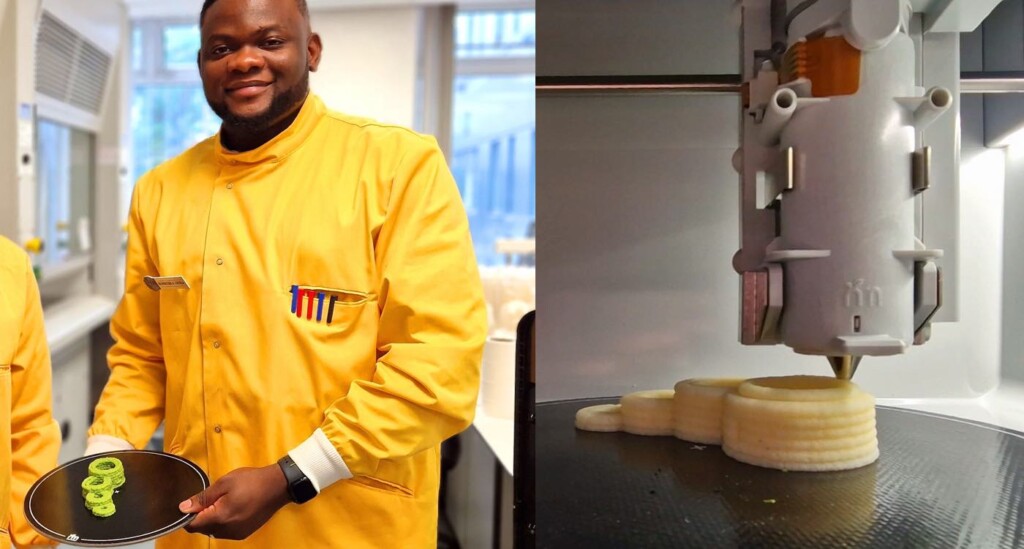
PhD student Oluwatobi Fatola 3D printing food for people with swallowing difficulties- UWE Bristol / SWNSnnScientists at a British university have become the first create 3D printed food–to help people with swallowing difficulties.nnAcademics led by UWE Bristol have used an extrusion-based 3D food printer to produce meals which are easy to chew, swallow, and digest.nnMeals produced for the research were developed alongside clinical nutritionists to ensure they were complete, multi-ingredient, nutrient-rich dishes suitable for people with dysphagia.nnTrying to overcome the problem of pureed foods often being bland, unappetizing in texture, and lacking in nutritional variety, the team made their food using pureed garden peas, strained Greek yogurt, extra virgin olive oil, powdered organic mint leaves and vegetable stock.nnThe researchers experimented by trying different novel combinations of food grade thickeners and gelling agents until they identified an optimum formulation that provided a texture and viscosity suitable for people with the disorder.nn“With our 3D printed food, there is significantly less risk of food particles sticking in the throat or the oesophagus, which can be very problematic for people with dysphagia,” said Dr. Alexandros Stratakos, Associate Professor in Sustainable Agri-Food Production at UWE.nn”It requires less chewing and has a specially formulated structure which gives more control of the food to the person with dysphagia.nn“Previous research on 3D printed food suitable for dysphasia has focused on meals with only one or a small number of ingredients and has paid less attention to the nutritional profile of the food.nn“Our food product is the first that is suitable for people with dysphagia, but at the same time is nutritious, palatable and rich in calories.nn3D Printer Healing:Woman Given New 3D-Printed Windpipe in World Firstnn“As researchers we try to solve real life problems and dysphagia is a very important one. It is a growing issue due to our aging population and will become a bigger healthcare burden both in the UK and internationally.nn“This study highlights the importance of bringing together multidisciplinary expertise, in this case on food science, additive manufacturing and dietetics/nutrition, to develop novel solutions for real-world problems.”nnEstimates suggest that up to 16% of the UK population has dysphagia – with the condition more common among older adults and individuals with certain health conditions including stroke patients and dementia patients.nnTo make the food, the researchers added ingredients to cartridges which are placed inside the 3D printer. When the machine is switched on, the ingredients are extruded like ‘ink’ through nozzles onto a plate. (Watch the video below…)nnLayers are deposited on the surface of the plate in a pre-programmed shape, then multiple layers are added to build a three dimensional object.nn3D Printing Magic:Scientists Are 3D-Printing Stem Cells that Can Be Implanted as Brain TissuennMeals can be produced quickly, in approximately 20 minutes, and printed in a variety of attractive patterns and shapes.nnA survey showed UK-based dysphagia patients, and their caregivers, were ‘overwhelmingly positive’ about the concept of the type of 3D-printed meals produced in the study. Respondents said if they were commercially available they would be willing to purchase the meals, which are high in fiber and protein.nnFollowing the success of their lab-based research, the team now hopes to secure funding to conduct a clinical trial.nnDr. Stratakos said he could envision 3D food printers eventually being introduced to care homes and hospitals to enable food produced on site. “We have taste-tested the food ourselves here in the lab and it tastes great.”nn3D HOUSING: First 3D Printed Neighborhood is Providing 100 Sturdy Affordable Solar Homes Near Austin For $400K+nnDr. Clare Jonas at the Stroke Association said swallowing problems affect around half of all stroke survivors—and this can be dangerous, causing foods to ‘go down the wrong way,’ which can lead to choking or lung infections. “Safety is therefore a primary concern, but healthy and palatable meals matters too.”nnThe project was an international collaboration between the UK, Greece, and Serbia, including researchers from the University of the Peloponnese and University of Novi Sad.nn[raw][/raw]nnSHARE With Compassionate Research On Social Media…