
Farmers Use Bees to Deter Elephants from Romping Over Crops–a Win-Win for All

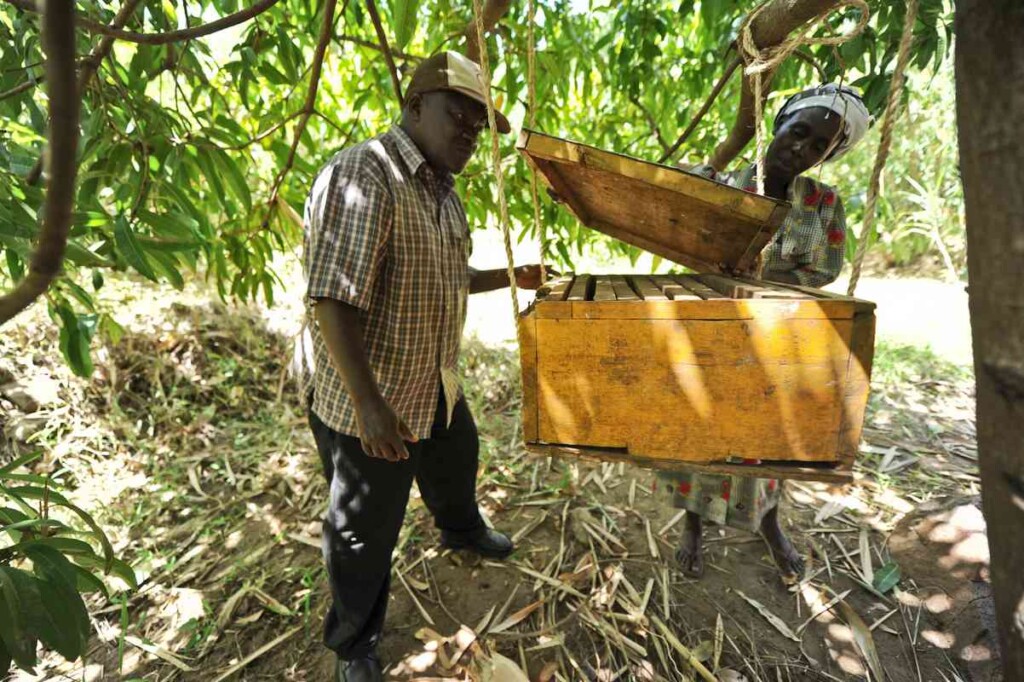
Beekeepers in Kenya – credit, CGIAR K. Trautmann, CC 2.0. Flickr 
nnIn Kenya, on the edge of the legendary Tsavo National Park, African honey bees contentedly buzz about near rows of well-tended crops.nnIt’s a scene that’s becoming more common in these rural areas and is driven by an extreme need: to deter elephants from encroaching on farmlands, eating crops, and destroying homes.nn”The beehive fences came to our rescue,” said Kenyan farmer Charity Mwangome “We used to hate elephants a lot.”nnMwangome told AFP that she and many farmers like her live in perpetual fear that these 8-ton animals would at any moment during the growing season come storming in to eat and trample away her livelihood.nnElephant conservation has been dramatically successful in Tsavo, where their numbers have risen almost 300% since the 1990s—to 15,000 individuals. However the increase in their population has also led to increases in conflict events with rural villagers.nnTo combat this, the charity Save the Elephants is working to turn villagers into beekeepers. It costs almost $1,000 to get started, which is a major flaw in the project that nevertheless has recruited 49 beekeepers so far, but the honey is a valuable commodity that can bring in enough to pay for school and school supplies with just a couple of jars.nnUSING NATURE RATHER THAN EXPLOITING IT: African Forest Farming Initiative Making A Difference to Thousands with Tree-Planting and MicrolendingnnThe elephants, meanwhile, are scared away by the hum of 70,000 bees. The hives installed by Save the Elephants are hung from greased wire to protect them from badgers, but also serve to form a convenient trip wire if an elephant is brave enough to investigate the noise and smell. The shaking of the wire disturbs the bees into a frenzy.nnSuccessful beekeeping operations have also been established in Zambia in Malawi—around protected areas and national parks filled with wildlife.nnMORE STORIES LIKE THIS: This Fencing Club Is Giving at-risk Youth in Kenya an Elegant Alternative to Street ViolencennLast year, the International Fund for Animal Welfare delivered nearly 300 beehives to cooperatives in four chiefdoms around Kasungu, one of the two regions that make up the Malawi–Zambia Transfrontier Conservation Area (TFCA), a gargantuan 32,000 square kilometer area of national parks, wildlife reserves, forest reserves, game management areas, and communal lands, where beekeeping is used to enrich communities, dissuade community members from poaching, and deter elephants.nnTRUMPET This Great News About Detering Elephants And Saving Bees…

Share the Post:

Related Posts