— Elon Musk (@elonmusk) October 14, 2024
[/raw]nn[raw]
Sometimes things do work after all https://t.co/ApGw5wLHHD
— Elon Musk (@elonmusk) October 16, 2024
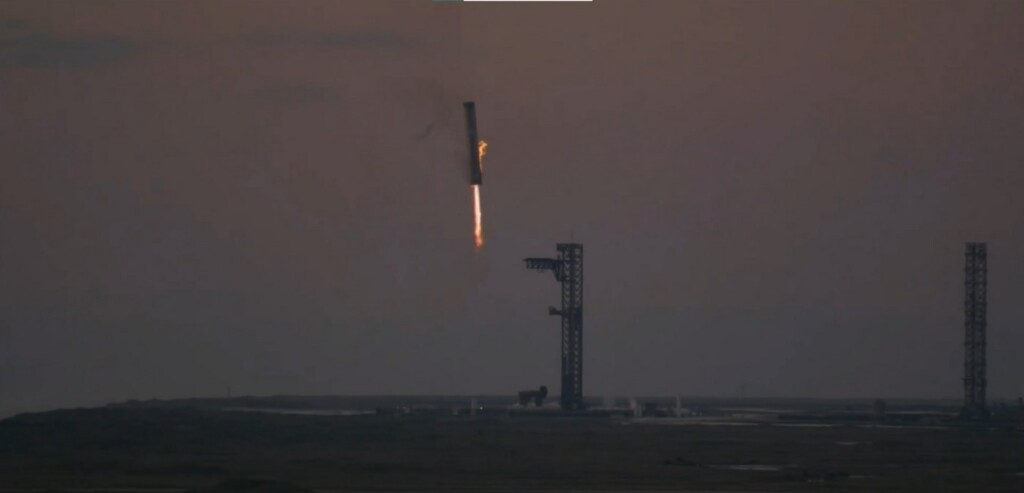
[/raw]nThe second component of the Starship rocket made it to orbit as intended, before re-entering Earth’s atmosphere, activating 3 of its 6 boosters as it hovered over the Indian Ocean—another demonstration success, before exploding.nnThis is Starship’s 5th test flight. The vehicle has been designed according to SpaceX Founder Elon Musk’s dream of landing humans on Mars during his lifetime. NASA has piggybacked on his ambition, ordering several Starships for the upcoming Artemis missions that aim to return humanity to the Moon with the purpose of establishing a semi-permanent lunar presence.nnThe historic moment comes just one month after a member of the crew onboard the SpaceX Dragon capsule performed the first-ever civilian spacewalk, proving the design of SpaceX’s new lightweight spacesuits, worn by the crew to travel seamlessly in and out of the capsule.nnAn analysis by NASA found that the SpaceX Falon 9 has reduced the cost of a rocket launch by a factor of 20. The cost of a Falcon 9 and Dragon capsule mission to ISS is about $140 million with a payload of 6,000 kg, $23,300/kg, compared to the Space Shuttle which was about $1.5 billion.nnThe analysis was made when Falcon 9 rockets fell back down to Earth to be destroyed. To aid in humanity becoming a multi-planetary species, that cost has to continue to fall substantially, and a rocket that needs only to be refueled rather than rebuilt is a major step toward making space travel around the same cost structure as commercial aviation.nnTHE FOLLOWING VIDEO CONTAINS CELEBRATORY PROFANITY…nn[raw]
Watching this one over and over pic.twitter.com/NODBkBaerd
— piet (@piet_dev) October 14, 2024
Watching this one over and over pic.twitter.com/NODBkBaerd
— piet (@piet_dev) October 14, 2024
[/raw]nnSHARE This Chapter In The Engineering History Books With Your Friends…