41 years ago today, the meter was standardized to its current form, providing grounds for all the subsequent increments such as millimeters, centimeters, and kilometers for most of the countries of the world. Originally fixed in 1791 by the French, it was changed by the International Committee of Weights and Measures to represent the distance light traveled in a vacuum over a time span of one 299,792,458th of a second. This would place the photons in the same place with 0.1 nanometers of variation and is the best scientists have done so far. READ other ways the meter has been fixed… (1983)nnnn nnThe meter was originally defined in 1791 by the French National Assembly as one ten-millionth of the distance from the Equator to the North Pole of the length of a great circle quadrant along the Earth’s meridian through Paris, that is the distance from the Equator to the North Pole along that quadrant.nnIn 1889, at the first International Conference on Weights and Measures, the meter was set at the distance between two lines on a standard bar of an alloy of platinum with 10% iridium, measured at the melting point of ice.nnMore Good News on this Date:n
- n
- 79 years ago today, Women in France were finally awarded the right to vote for first time—decades later than most Western countries, including New Zealand, Australia, the US, UK, Finland, and Norway (1945)
n
n103 years ago today, Warren G. Harding delivered the first speech by a sitting U.S. President that condemned the lynching of African Americans in the deep South—despite widespread political opposition among white voters.nn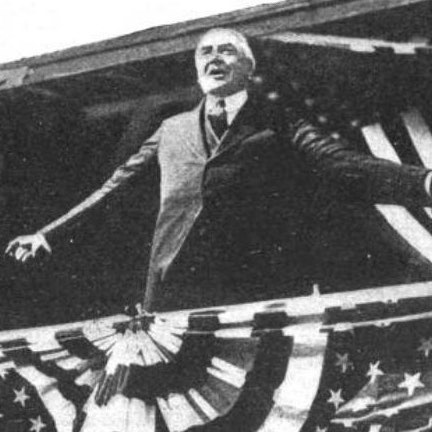 nnThe Republican had been advocating for the civil rights of Blacks throughout his presidential campaign in 1920, and made the speech in Alabama, where the illegal hangings—an average of two per week—were committed primarily by white supremacists. In the Birmingham speech, President Harding voiced support for anti-lynching bills pending in Congress that would levy fines and prosecution against counties and officials where they occurred. (1921)nnOn this day in 1854, Florence Nightingale, founder of the nursing profession, left for Turkey with 38 women she’d trained to tend to British soldiers dying from unsanitary conditions in the Crimean War.nn
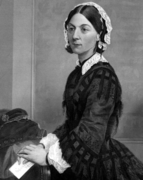 nnBeyond her nursing skill, she was a noted statistician, she charted seasonal sources of patient mortality in the military field hospital she managed.nnAnd, 84 years ago today, Ernest Hemingway’s novel For Whom the Bell Tolls was first published.nn
 nnA story about a young American volunteer who joined the government of Spain as a guerrilla fighter during the Spanish Civil War, a conflict that was widely viewed as a dress rehearsal for the Second World War because the Italian Fascists and German Nazis were supporting an overthrow.nnBased on Hemingway’s own experiences during that war, where he had been a journalist, it was regarded as one of Hemingway’s best works. The book sold half a million copies and was nominated for a Pulitzer Prize. (1940)nn
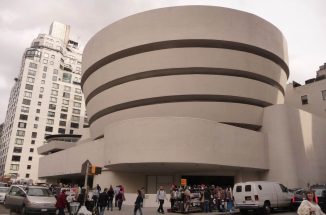 nn65 years ago today the spectacular Guggenheim Museum, designed by Frank Lloyd Wright, opened in New York City. A landmark of 20th-century architecture, the cylindrical building, wider at the top than the bottom, was conceived as a “temple of the spirit” with a unique ramp exhibiting art along its outer wall extending up in a long, continuous spiral drenched in skylight from above. WATCH a video of its gorgeous interior… (1959)nn[raw][/raw]nn nnAlso on this day in 1917, Dizzy Gillespie, the jazz trumpeter, composer, and singer, was born in Cheraw, South Carolina. A virtuoso improviser, he added layers of harmonic complexity previously unheard in jazz.nn