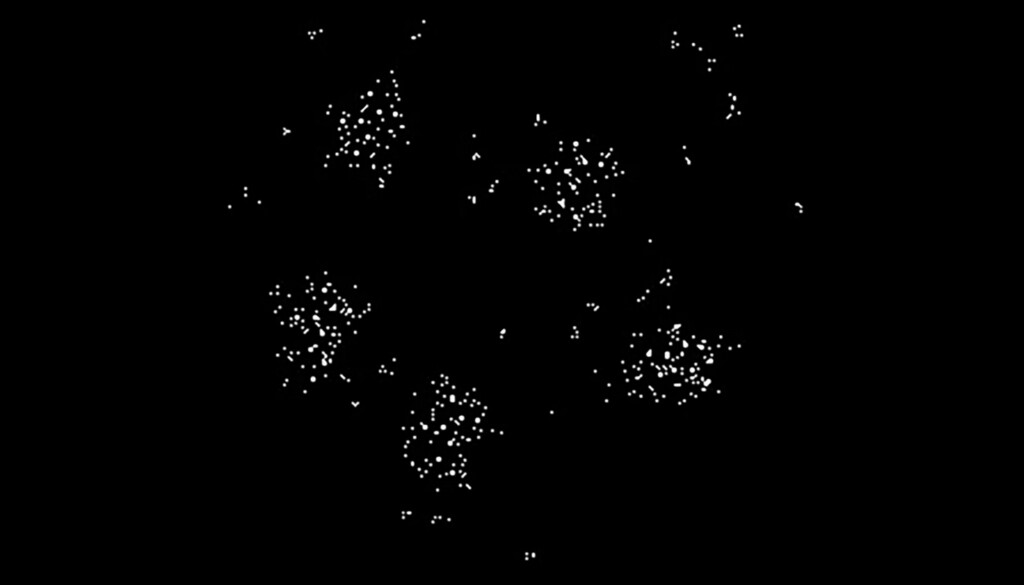
– credit A Sign in Space.nnThese white dots arranged in five clusters against a black background simulate an extraterrestrial signal transmitted from Mars and deciphered by a father-daughter team on Earth after a year-long decoding effort.nnThe project was organized by some of the world’s top astronomers to run the scenario of a citizen science response in the event of a real interstellar communication.nnThere’s no telling what form such a communication would take, but Ken and Keli Chaffin, demonstrated that there are enough brilliant and interpretive minds out there to tackle it.nnIn truth, the whole exercise was an art project called A Sign in Space, organized by the science research nonprofit Search for Extraterrestrial Intelligence (SETI) in partnership with the European Space Agency.nnLast year, the agency sent a radio signal back to Earth from the ExoMars Trace Gas Orbiter, a research craft currently orbiting the Red Planet in search for evidence of methane and other trace atmospheric gases that could be signatures of active biological or geological processes.nnAfter three radio astronomy observatories on Earth intercepted the communication, the challenge was first to extract the message from the raw data of the radio signal, and secondly to decode it.nnIt took 10 days for a community of 5,000 citizen scientists on Discord to extract the signal from the raw data that was released to the public by the observatories, which included the signals from many other spacecraft as an additional challenge. The second task took longer and required some visionary minds.nnLike the plotline from an episode of Lost in Space, American father and daughter Ken and Keli Chaffin cracked the code by following their intuition.nnThey ran simulations for hours and days on end, trying to assemble the message into all kinds of different forms before the family discovered that the message contained movement—it stayed in motion and only displayed in any configuration for about one-tenth of a second.nnTo them, its characteristics suggested some sort of cellular formation. What appeared on their screens to be clusters of white pixels were believed by the Chaffins to be amino acids and proteins—the building blocks of life.nnDesigned by media artist Daniela de Paulis with help from astronomers and computer scientists, amino acids were the correct guess—the Chaffins’ intuition was right.nnThe citizen scientists received and communicated about the project via the online chat and community platform Discord, and referred to the message as the “Starmap.” When Ken Chaffin first saw the Starmap, he guessed that a cellular automata algorithm produced it. Cellular automata is a sequence of units programmed to follow certain movements and patterns, and Chaffin had amateur experience working with them, he told CNN.nn“I had no idea what the message would show or say. I suspected that it might have something to do with life,” he added, saying he immediately recognized them to be amino acids from school chemistry classes.nnKeli Chaffin, his adult daughter, initially had no plans to join her dad in the immersive effort, but she said she quickly became mesmerized by the vastness of the project.nnSIMILAR FATHER DAUGHTER DUOS: 8-Year-old Girl Gets to Chat with Orbiting Astronaut Using Dad’s Ham Radionn“The original image that looks like a Starmap has always given me the appearance of biological lifeforms,” she said in an email. “(A) lot of members have seen a mouse, a starfish, or an elephant.nnDe Paulis said that if we ever received a radio message from an alien civilization, there’d be no one to tell humanity whether we had interpreted it correctly. Animo acids were what de Paulis was getting at, but as Keli divined, meanings abounded within the data.nnIt’s not the first time a major space organization has used billion-dollar space equipment to test humanity’s brightest citizens. When the parachute deployed to slow the Perseverance Mars rover’s descent to the Red Planet, NASA teased it contained a message. nnMORE SCIENCE STORIES TO INSPIRE: NASA to Send ‘Message in a Bottle’ Into Space Designed to Communicate With ExtraterrestrialsnnTo non-mathematicians, it just seemed like a weirdly designed parachute pattern, but citizen scientists and maybe some real scientists also, took just six hours to decode the message hidden in the parachute.nnMatching the variations in color to binary code, before translating that into English letters and numbers, they found it read “Dare Mighty Things.”nnSHARE This Inspiring Art-Science Project With Your Friends…